When selecting an NdFeB magnet manufacturer, buyers are not just choosing a raw material supplier—they are selecting the long-term stability of an entire magnetic system. In applications such as electric motors, sensors, automotive actuators, and industrial automation, small variations in coating quality, dimensional tolerance, or magnetization direction can directly affect performance, yield rate, and product reliability.
Because NdFeB magnets are both high-performance and chemically sensitive, a structured supplier evaluation process is essential before mass production.
Coating Quality: First Barrier Against Corrosion Failure
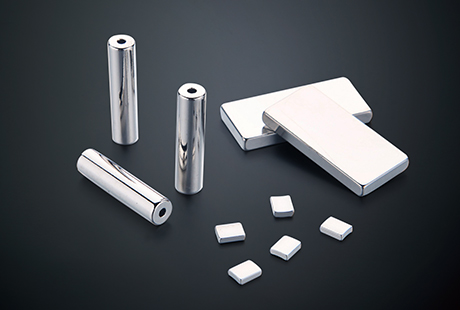
Coating is one of the most critical quality indicators when evaluating an NdFeB magnet manufacturer, because NdFeB materials are highly vulnerable to corrosion, especially in humid, salty, or industrial environments. A poor coating layer can quickly lead to oxidation, magnetic degradation, and structural failure. Key coating requirements in industrial applications include uniform coating thickness without exposed base material, strong adhesion between coating and magnet substrate, common systems such as Ni-Cu-Ni, epoxy, or zinc plating, as well as no pinholes, cracks, or peeling after stress testing, and good compatibility with high-humidity or outdoor environments. In real production environments, coating consistency often determines whether a magnet can survive long-term service conditions or fail prematurely in field applications.
Dimensional Tolerance and Magnetization Precision in Mass Production
Unlike general metal components, NdFeB magnets are often used in precision assemblies where mechanical fit and magnetic alignment must work together. That makes dimensional tolerance and magnetization control a key part of supplier evaluation. In modern manufacturing systems, even small deviations can lead to assembly problems or performance loss. High-quality manufacturers typically maintain strict control over both geometry and magnetic field consistency. A reliable supplier should ensure:
· Tight dimensional tolerance control for automated assembly
· Consistent batch-to-batch size stability
· Accurate magnetization direction (axial, radial, or multipole)
· Stable magnetic flux distribution for system-level consistency
· Low variation in magnetic strength across production lots
These factors are especially important in high-speed production lines where manual correction is not feasible and automation demands repeatable precision.
Salt Spray Testing and Environmental Reliability
For many industrial and automotive applications, NdFeB magnets must operate in environments where moisture, vibration, and temperature changes are unavoidable. In such cases, coating alone is not enough—real environmental validation is required. Salt spray testing is commonly used to simulate long-term corrosion exposure. It helps determine whether a magnet can maintain performance under aggressive conditions such as coastal humidity or industrial chemical exposure. A qualified NdFeB magnet manufacturer should be able to demonstrate:
· Stable performance after prolonged salt spray exposure
· No visible rust or coating failure during testing cycles
· Consistent magnetic strength after environmental aging
· Verified compliance with industrial durability standards
This testing step is often what separates general suppliers from industrial-grade manufacturers.
Packaging, Handling and Assembly Capability
Even if magnets pass coating and performance tests, improper packaging or lack of assembly capability can still cause real-world quality issues. NdFeB magnets are mechanically fragile and generate strong attraction forces, which means poor handling can result in chipping, demagnetization, or coating damage. Professional suppliers typically integrate packaging and assembly considerations into their production process. This includes protective isolation between parts, anti-collision structures, and clear polarity labeling for downstream assembly efficiency. In advanced supply chains, assembly capability has become increasingly important because many OEM customers now require not just magnets, but fully integrated magnetic components ready for direct installation. This reduces labor cost, improves alignment accuracy, and shortens production cycles.
Engineering Selection Perspective
When evaluating an NdFeB magnet manufacturer, engineers should not focus on a single parameter such as magnetic strength. Instead, the decision should be based on a complete system view that includes coating durability, dimensional precision, magnetization control, environmental resistance, and supply chain consistency. In real-world applications, the most successful suppliers are those that can deliver stable batch quality while supporting scalable production requirements. Jintian Copper focuses on providing industrial-grade NdFeB magnet solutions and magnetic assembly support to meet the needs of automotive, electronics, and industrial automation industries.
FAQ: NdFeB Magnet Manufacturer Selection
Why is coating quality so important for NdFeB magnets?
Because NdFeB materials are highly prone to corrosion without proper surface protection, especially in humid environments.
What does dimensional tolerance affect?
It directly impacts assembly fit, automation efficiency, and magnetic alignment in final products.
Why is magnetization direction critical?
Incorrect or inconsistent magnetization can cause system failure or reduced efficiency in motors and sensors.
Is salt spray testing necessary?
Yes, it verifies long-term corrosion resistance and coating durability under harsh conditions.

 English
 한국어
한국어 français
 Deutsch
 Español
 italiano
 العربية
 tiếng việt
 Türkçe
 ไทย
ไทย 中文
中文