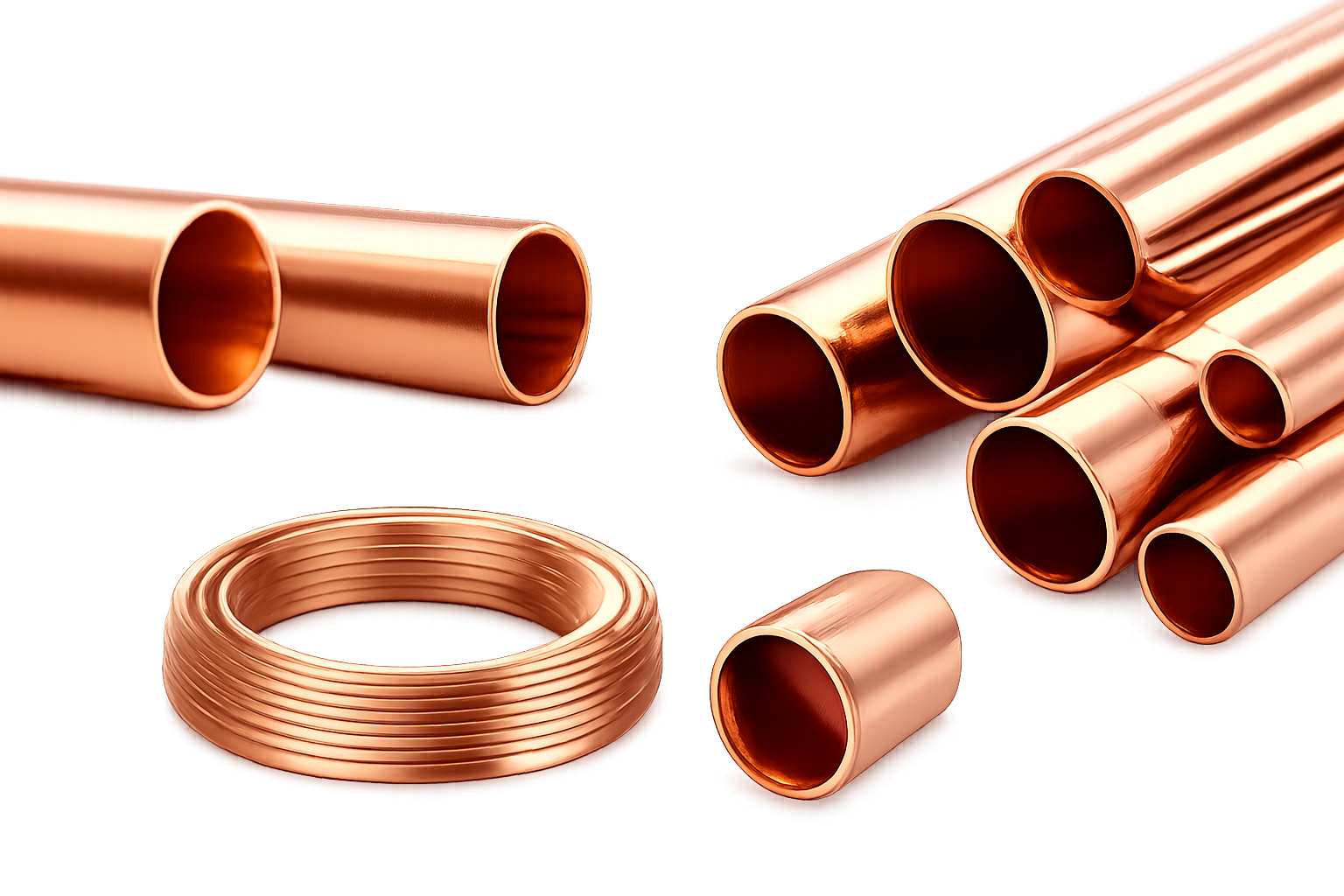
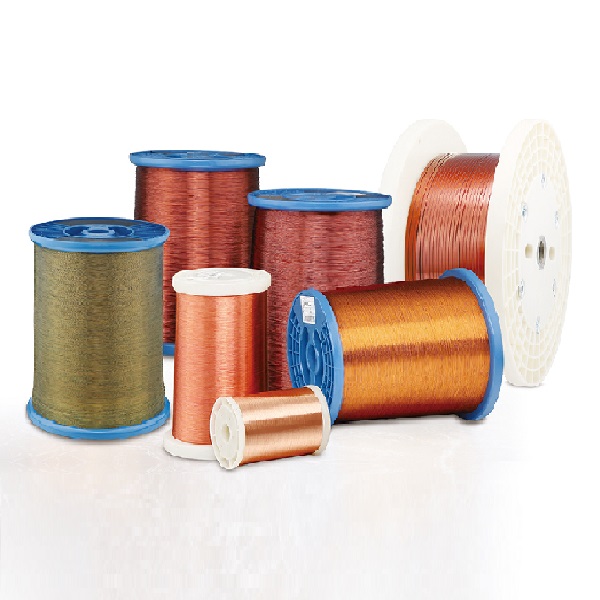
The Same Electrical Copper Rod: One from the Cathode Copper Route and One from High-Grade Recycled Copper — If Both Meet the Requirements for Conductivity and Room-Temperature Mechanical Properties, Are They Really Completely Equivalent?
In 2026, this is no longer just a question in materials laboratories. The Indian copper industry has publicly debated whether fire-refined high-conductivity (FRHC) recycled copper rods can enter unified electrical copper rod standards. At the same time, ASTM is advancing revisions to the B49 electrical copper rod standard, proposing an ETP-R route targeting recycled content and reconsidering the allowable ranges of residual elements such as Fe, Sn, and Ni, while the prerequisite remains maintaining conductivity and annealing performance.[1-2]
The core of the debate is not “whether scrap copper can conduct electricity,” but a more fundamental materials science question: Should high-end conductors be evaluated based on average performance, or based on those rare but critical local defects that are sufficient to cause an entire coil of fine wire to fail?
What high-end conductors truly fear is often not poor average performance, but occasional defects.
01|Why Can’t Meeting Conductivity Requirements Alone Prove That It Is a “High-End Copper Rod”?
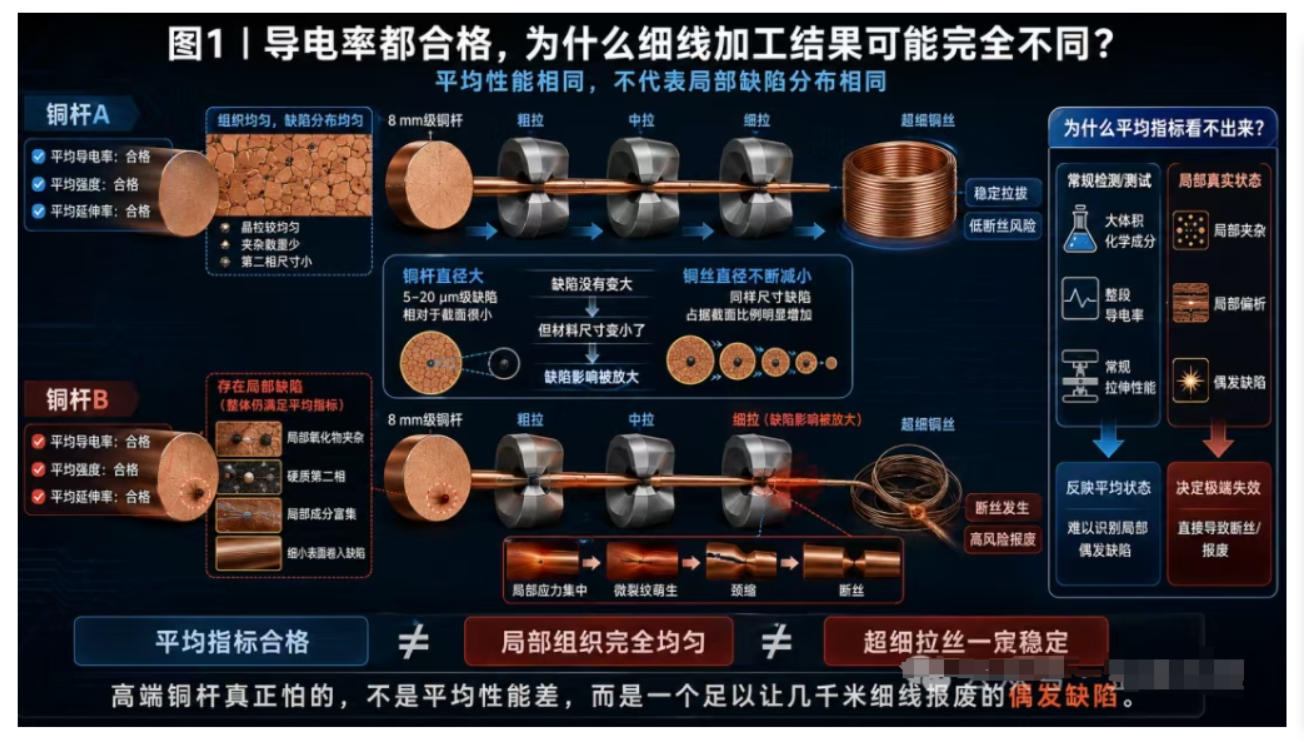
Conductivity is an “average value.” As long as the overall effects of solid-solution impurities, dislocations, and grain boundaries on electron scattering are controlled, a batch of copper rods can completely achieve excellent IACS values. The problem is that downstream users do not keep the copper rod at its original size. It must undergo multiple drawing passes and continuous annealing before finally becoming fine wires, stranded wires, or even micro conductors.
At this scale, the effects of local oxides, hard second phases, entrapped inclusions, or abnormal microstructures are rapidly amplified. A defect-free appearance at the coarse wire stage does not guarantee reliability after being drawn down to several tens of micrometers; a tiny defect can become the starting point of wire breakage. Industrial studies on fire-refined copper rods have also shown that the distribution of impurities and oxygen significantly affects torsional properties and microstructure performance, rather than being determined only by “total copper content.”[3]
02|What Is Truly Difficult to Control Is the “Impurity Spectrum,” Not the Total Copper Content
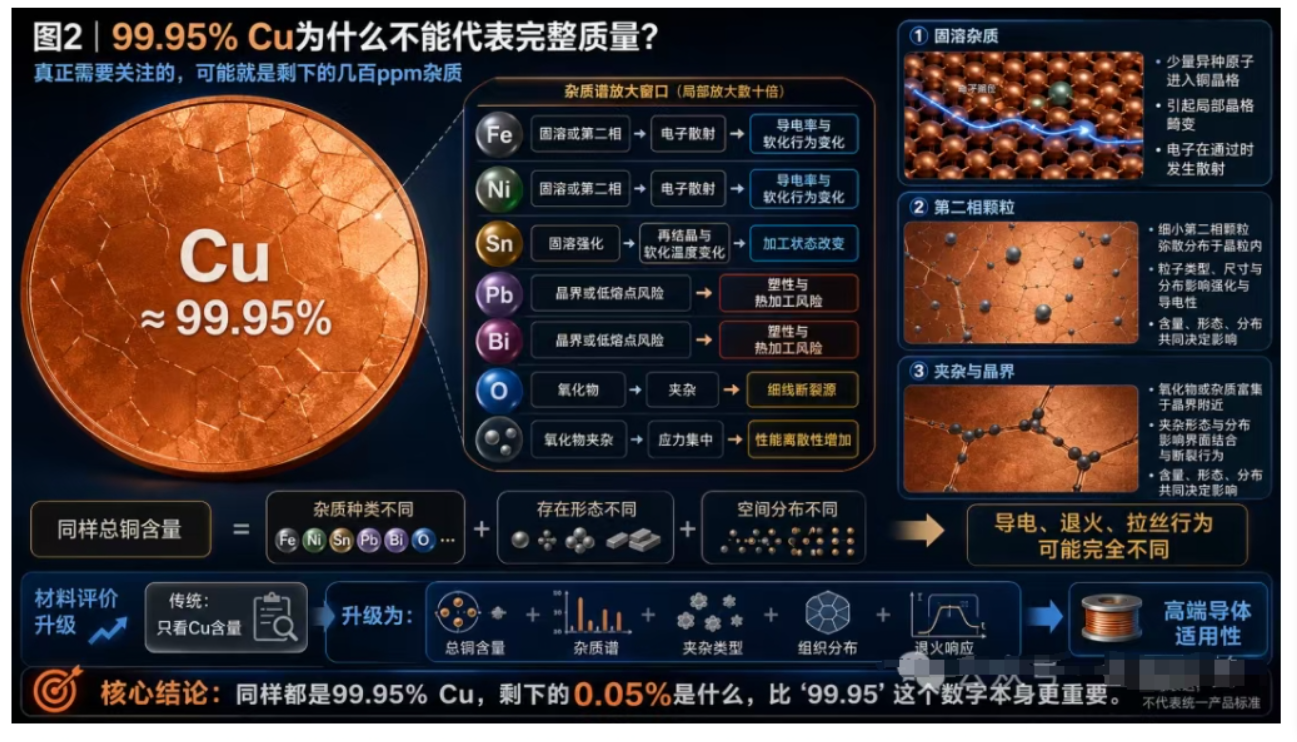
“99.9% copper” and “99.99% copper” are intuitive concepts, but for high-end conductors, what remains in the material is often more important than how many nines appear after the decimal point. Different elements exist in copper in different forms: some form solid solutions and directly increase electron scattering; some participate in oxide or second-phase formation; some affect recrystallization and grain growth; and others change the subsequent softening window.
The reason ASTM WK85830 does not simply relax a “total impurity limit” for recycled copper, but instead specifically discusses elements such as Fe, Sn, and Ni, is that both the “type of impurities” and the “amount of impurities” must be controlled simultaneously.[2] Early copper wire studies also proved that even ppm-level differences in Pb and Sn can alter the softening behavior of cold-drawn copper wires.[4]
Even with the same high copper content, the remaining hundreds of ppm of elements may determine completely different processing windows.
03|Why Can “Annealing Response” Reveal Problems More Clearly Than Finished-Product Strength?
Copper rods are only semi-finished products. After entering the customer’s production line, they undergo large deformation drawing and then continuous annealing to recover ductility. During this process, the material experiences recovery, recrystallization, and grain growth, and previously “hidden” impurity and oxide distributions participate again in microstructural evolution.
Research shows that copper rod manufacturing methods, Cu₂O particle distribution, and trace impurities can alter the softening temperature and elongation after annealing of cold-drawn copper wires. Heat treatment that causes certain impurities to precipitate from the matrix can also change conductivity and softening behavior.[4-5] Therefore, two copper rods with similar conductivity and tensile strength when leaving the factory may reveal real performance differences only after entering the “drawing + annealing” process.
A high-end copper rod is not simply one that is qualified when leaving the factory; it must remain qualified after further customer processing.
04|What Recycled Copper Truly Needs to Overcome Is “Identity Management”
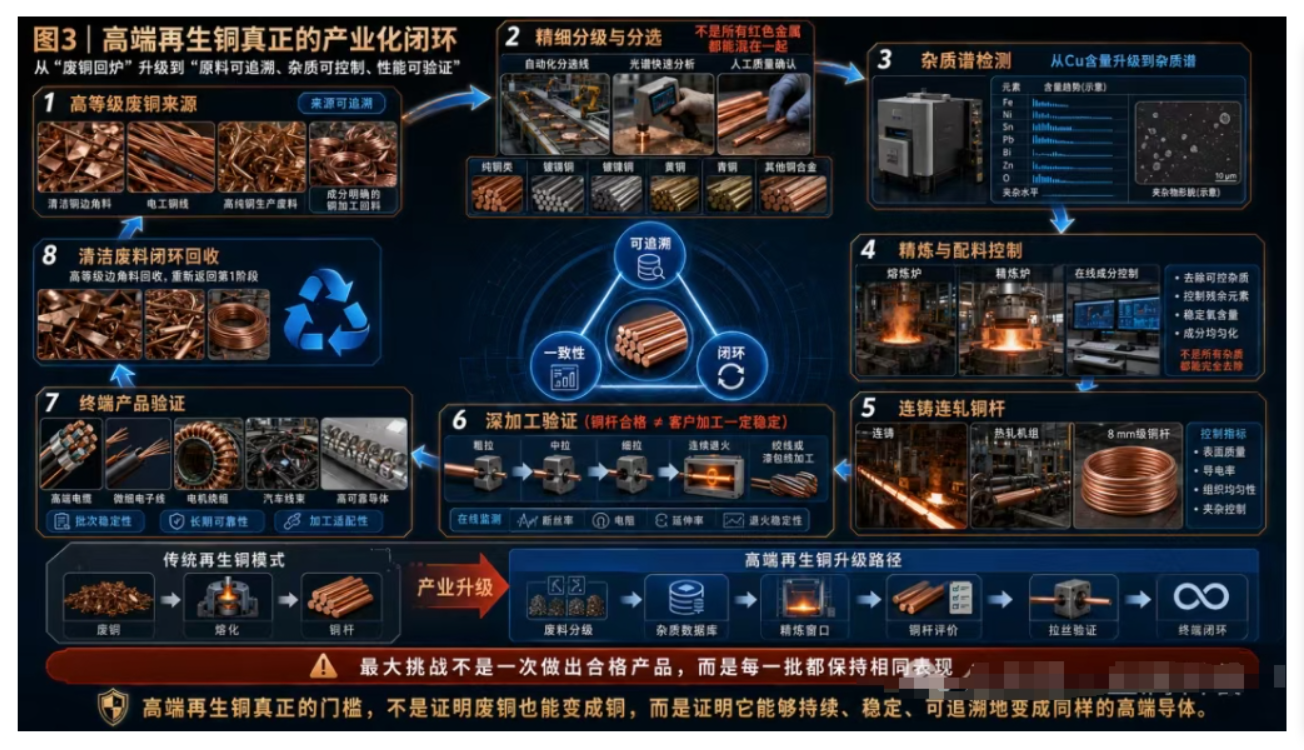
Therefore, allowing recycled copper to enter high-end conductors does not mean it is “impossible,” nor should it simply be understood as “meeting a certain conductivity requirement means it can replace primary copper.” A more realistic direction is to transform recycled copper from anonymous mixed raw materials into engineering materials that are classified, traceable, and predictable.
The truly competitive route in the future should be:
High-grade scrap classification → Source traceability → Impurity spectrum database → Fire refining/electrolytic refining and charge control → Online copper rod inspection → Wire drawing and annealing verification → Closed-loop recycling of clean scrap.
Commercialized FRHC copper rods have already demonstrated that scrap copper can re-enter the electrical material system through refining, but different application levels still require different quality boundaries.[6]
Therefore, what high-end recycled copper truly needs to prove is not that “scrap copper can also be made very pure,” but whether it can continuously, stably, and traceably produce the same microstructure, the same annealing response, and the same low probability of wire breakage.
Finally, here is a truly worthwhile question for industry discussion:
Assuming two copper rods have the same conductivity, composition, and room-temperature mechanical properties, with one coming from cathode copper and the other from high-grade recycled copper — would you allow them to enter the same high-end fine wire production line?
If not, what would concern you the most: inclusions, annealing response, wire breakage rate, batch consistency, or raw material traceability?
Readers are welcome to directly share their application scenarios. Those working in copper rods, wire drawing, magnet wire, cables, or material testing are also welcome to leave their practical experience in the comments. The most highly discussed issue will be further analyzed in the next article.
References and Further Reading
[1] Reuters. India’s top copper producers oppose inclusion of scrap-based rods in standards. 2026-05-19.
[2] ASTM WK85830. Revision of B49-20 Standard Specification for Copper Rod for Electrical Purposes. ASTM International.
[3] Su Huaguang. Effect of Impurity Distribution on the Properties of Fire-Refined Copper Rods. Electric Wire & Cable, 2020.
[4] Aoyama S, Onuki M, Miyake Y, Urao R. Effects of Hot-Working Processes and Impurities on the Properties of Cold-Drawn Cu Wires. Journal of the Japan Institute of Metals, 1987, 51(9): 858-863.
[5] Aoyama S, Onuki M, Miyake Y, Urao R. Effects of Heat-Treatment of Hot-Rolled Copper Wire Rods on the Spring Elongation Number of Annealed Copper Wires. Journal of the Japan Institute of Metals, 1989, 53(4): 452-457.
[6] EPD International. ECOCOBRE (FRHC) Copper Wire Rod, Environmental Product Declaration.
[7] Li et al. Contribution of grain boundary to strength and electrical conductivity of annealed copper wires. Journal of Materials Research and Technology, 2023, 26: 1459-1468.

 English
 한국어
한국어 français
 Deutsch
 Español
 italiano
 العربية
 tiếng việt
 Türkçe
 ไทย
ไทย 中文
中文