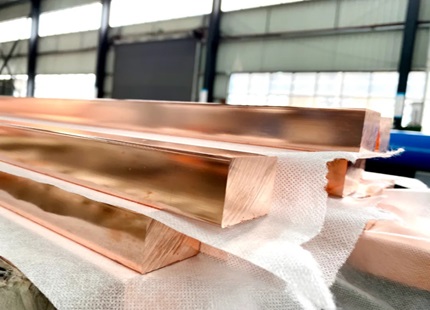
Cu-DHP vs Cu-ETP: Selecting the Right High-Conductivity Copper
When choosing between high-conductivity copper grades, electrical conductivity is only part of the decision. How copper responds to brazing, welding, forming, and other processes can be equally important. Cu-DHP and Cu-ETP are not always interchangeable, even though both are widely used in industrial applications.
Cu-DHP is phosphorus-deoxidized copper (EN CW024A / UNS C12200), while Cu-ETP (EN CW004A / UNS C11000) is electrolytic tough-pitch copper. Their different oxygen characteristics give them distinct advantages in manufacturing and end-use applications. Understanding these differences helps engineers determine when Cu-DHP is the more appropriate choice.
What Is Cu-DHP and How Does It Differ from Cu-ETP?
Cu-DHP (CW024A / C12200) is a deoxidized, essentially oxygen-free copper with controlled residual phosphorus content. During production, phosphorus reduces the oxygen content, resulting in a material well suited to heating and joining processes.
Cu-ETP (CW004A / C11000) is electrolytic tough-pitch copper with controlled residual oxygen (typically ≤ 0.04% / ≤ 400 ppm). It is recognized for excellent electrical and thermal conductivity and is widely used in electrical applications.
Main differences:
| Property | Cu-DHP (CW024A / C12200) | Cu-ETP (CW004A / C11000) |
| :--- | :--- | :--- |
| Copper type | Phosphorus-deoxidized copper | Electrolytic tough-pitch copper |
| Oxygen characteristic | Deoxidized, essentially oxygen-free (≤ 10 ppm) | Controlled residual oxygen (≤ 400 ppm) |
| Phosphorus content | 0.015–0.040% | Not applicable |
| Electrical conductivity | Approx. 85–90% IACS (49–52 MS/m) | ≥ 100% IACS (≥ 58 MS/m) |
| Brazing suitability | Excellent | Good with process control |
| Formability | Excellent | Good, temper-dependent |
| Common forms | Tube, sheet, strip, bar, rod | Sheet, strip, rod, wire, bar |
| Typical applications | HVAC/R, heat exchangers, plumbing, brazed assemblies | Electrical & conductive components |
Cu-DHP is not simply defined by its conductivity; its deoxidized composition provides specific advantages during thermal processing. Temper is another key consideration—a designation such as R240 describes a mechanical condition, not a separate grade. Grade and temper should always be specified together.
Cu-DHP vs Cu-ETP: Composition and Conductivity
Chemical composition explains each grade's processing characteristics.
Cu-DHP contains phosphorus (0.015–0.040%) as a deoxidizer, while Cu-ETP retains the oxygen characteristic of tough-pitch copper (≤ 0.04% O). This difference gives Cu-DHP advantages in applications exposed to elevated temperatures or certain joining processes.
From an electrical standpoint, Cu-ETP provides higher conductivity (≥ 100% IACS) and is preferred when minimizing resistance is the primary requirement. Cu-DHP offers approximately 85–90% IACS, which remains excellent for many applications despite being lower than Cu-ETP.
For those researching C11000 or C12200, always refer to the relevant material standard—composition limits, mechanical properties, and conductivity requirements vary by specification and product condition.
In short: Cu-ETP is favored when maximum conductivity is the priority; Cu-DHP provides an excellent balance of conductivity and thermal-processing performance.
Why Cu-DHP Performs Well in Brazing and Welding
Brazing is where the difference between Cu-DHP and Cu-ETP becomes critical.
During brazing, copper is heated to elevated temperatures (typically 600–800°C) and may be exposed to reducing atmospheres. Oxygen in copper can contribute to hydrogen embrittlement under certain conditions. Cu-DHP's phosphorus deoxidation substantially reduces this risk, making it particularly suitable for brazing applications.
Cu-DHP is widely used for:
- Refrigeration and air-conditioning tubing
- Heat exchangers and heat-transfer components
- Plumbing systems
- Brazed copper assemblies
Cu-ETP can also be brazed and welded, but process atmosphere, temperature, filler metal, joint design, and other parameters must be properly controlled—typically requiring inert gas shielding or vacuum brazing.
For manufacturers producing components that depend heavily on brazing, Cu-DHP provides a practical processing advantage.
Forming, Machining, and Manufacturing Considerations
Neither grade should be selected based on chemical composition alone. Manufacturing requirements significantly influence the final choice.
Cold forming, bending, drawing, rolling, and tube production all place different demands on copper. Temper is particularly important—it affects the balance between strength, hardness, and ductility.
For example, a softer temper (e.g., R220) is preferable for extensive forming, while a harder condition (e.g., R290, R360) provides greater mechanical strength and dimensional stability.
Manufacturers should evaluate:
- Temper — affects ductility, strength, and forming behavior
- Thickness and dimensions — influence forming limits and dimensional control
- Processing method — bending, drawing, rolling, and machining create different requirements
- Joining method — brazing and welding influence preferred grade
- Surface condition — matters for coating, electrical contact, brazing, or other surface treatments
Cu-DHP R240 for Formed and Brazed Components
When specified as Cu-DHP R240, "R240" refers to a specific mechanical temper. Per EN 1652 and industry data, Cu-DHP R240 typically provides:
- Tensile strength: 240–300 MPa
- Yield strength (0.2% offset): ≥ 180 MPa
- Elongation (A50): ≥ 8%
- Hardness (HV): 65–95
Cu-ETP R240 offers similar mechanical properties:
- Tensile strength: 240–300 MPa
- Yield strength (0.2% offset): ≥ 180 MPa
- Elongation (A50): ≥ 8% (dependent on thickness; confirm per applicable standard)
- Hardness (HV): 65–95
Select the appropriate temper based on component geometry and fabrication process. A brazed component may need bending, drawing, expanding, or other forming before joining. Proper temper balances forming needs with final mechanical performance.
Industrial Applications: Which Copper Is Better?
There is no universal winner—the better material matches the complete manufacturing process and service environment.
Cu-DHP is suitable when:
- Brazing or thermal joining is an important manufacturing step
- Copper tubes need forming and subsequent joining
- HVAC/R and refrigeration systems require reliable brazed connections
- Heat exchangers need suitable thermal-processing characteristics
- Plumbing components require good forming and joining performance
Cu-ETP is commonly considered when:
- High electrical conductivity (≥ 100% IACS) is the primary requirement
- Efficient current transmission is critical
- Material will be used for electrical strips, rods, wires, or conductive components
- Thermal joining is less important than electrical performance
How to Select the Right Copper Grade
A practical specification should answer several questions before ordering:
- What does the material need to do? — Start with conductivity, thermal performance, strength, and corrosion requirements.
- How will it be processed? — Consider bending, drawing, rolling, machining, brazing, and welding.
- What exact condition is required? — Specify grade, temper, thickness, dimensions, and applicable standard.
- Where will it operate? — Final environment and service conditions influence material choice.
For projects involving both forming and brazing, Cu-DHP offers a more suitable overall balance. When electrical conductivity is the dominant requirement, Cu-ETP is the logical starting point.
FAQ
Is Cu-DHP suitable for heat exchanger manufacturing?
Yes. Cu-DHP is widely used for tubing and components in heat exchangers, particularly where brazing is involved.
Does Cu-DHP have good electrical conductivity?
Yes. Cu-DHP provides approximately 85–90% IACS, which is excellent for most applications, although Cu-ETP offers ≥ 100% IACS.
What does "DHP" designation mean?
DHP stands for Deoxidized High Phosphorus copper, indicating phosphorus is used to deoxidize the copper during production.
Can Cu-DHP be used for cold forming?
Yes. Cu-DHP offers excellent cold formability, though the appropriate temper should be selected for the required forming operation.
Does temper affect copper selection?
Yes. Temper directly influences strength, ductility, hardness, and forming behavior.
What should buyers specify when ordering Cu-DHP?
Specify grade (Cu-DHP CW024A / C12200), temper (e.g., R240), product form, dimensions, applicable standard, surface requirements, and intended application.
Standards referenced (for verification):
EN 13601: Copper and copper alloys – Copper rod, bar and wire
EN 1652: Copper and copper alloys – Plate, sheet, strip and circles
ASTM B152 / B152M: Standard Specification for Copper Sheet, Strip, Plate, and Rolled Bar
ASTM B280: Standard Specification for Seamless Copper Tube for Air Conditioning and Refrigeration Field Service

 English
 한국어
한국어 français
 Deutsch
 Español
 italiano
 العربية
 tiếng việt
 Türkçe
 ไทย
ไทย 中文
中文